Artificial Intelligence
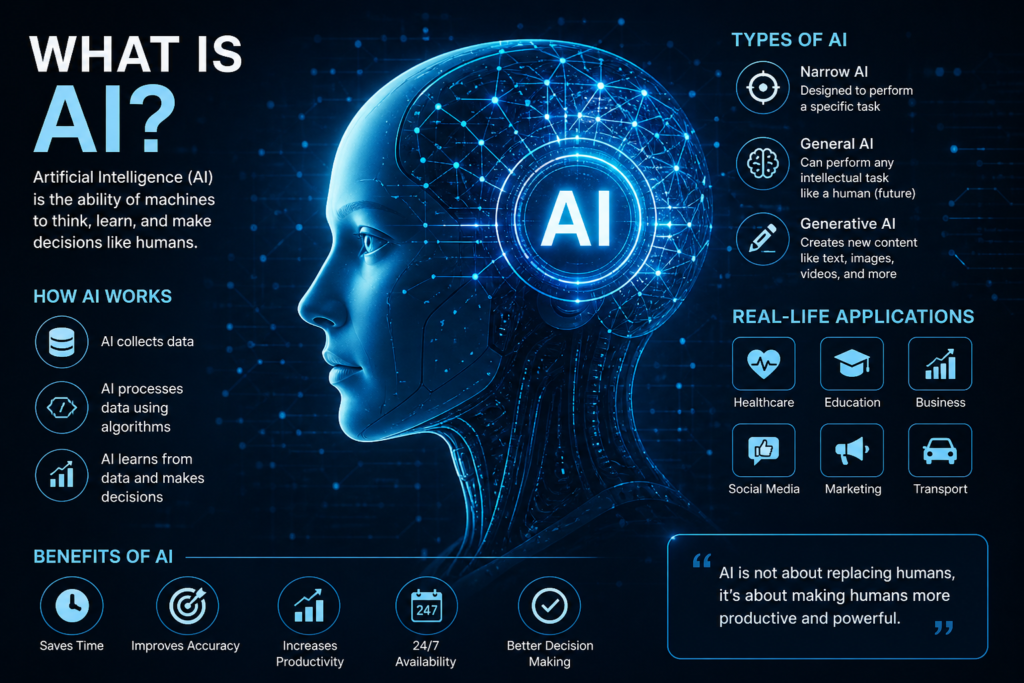
Artificial Intelligence (AI) is one of the most powerful technologies shaping our world today. In simple words, AI is the ability of machines or computers to think, learn, and make decisions like humans. Instead of just following fixed instructions, AI systems can analyze data, recognize patterns, and improve their performance over time.
You might already be using AI without realizing it. When you ask questions to ChatGPT, get video recommendations on YouTube, or use smart suggestions while typing on your phone, AI is working behind the scenes.
What Exactly is AI?
AI is a branch of computer science that focuses on creating intelligent machines. These machines are designed to perform tasks that usually require human intelligence. This includes understanding language, recognizing images, solving problems, and even making decisions.
Unlike traditional software, which follows strict rules, AI systems learn from experience. For example, if you show an AI system thousands of images of cats and dogs, it will learn to identify them correctly in new images.
Types of Artificial Intelligence
Narrow AI (Weak AI)
This is the most common type of AI used today. It is designed to perform a specific task.
Examples include:
- Voice assistants like Siri or Alexa
- Recommendation systems on Netflix or YouTube
- Chatbots for customer support
These systems are very good at one task but cannot perform beyond their programming.
General AI (Strong AI)
This is a more advanced form of AI that can think and perform any intellectual task like a human. It is still under development and not fully achieved yet.
Generative AI
Generative AI is a modern type of AI that can create new content such as text, images, videos, and music. Tools like ChatGPT and Midjourney are great examples. They can generate human-like responses and creative visuals.
How Does AI Work?
AI works using data, algorithms, and learning models. Here’s a simple explanation:
- Data: AI needs a lot of information to learn from
- Algorithms: These are the rules or methods AI uses to process data
- Machine Learning: A method where AI improves automatically by learning from data
For example, if an AI system is trained to recognize faces, it studies thousands of images to understand patterns like eyes, nose, and shape. Over time, it becomes better at identifying faces accurately.
Real-Life Applications of AI
AI is used in many areas of our daily lives:
1. Healthcare
AI helps doctors detect diseases early, analyze medical reports, and suggest treatments.
2. Education
AI tools provide personalized learning experiences, helping students learn at their own pace.
3. Business and Marketing
Businesses use AI to automate tasks, analyze customer behavior, and improve sales strategies.
4. Social Media
Platforms use AI to show relevant content based on your interests.
5. Design and Creativity
Tools like Canva use AI to help create designs quickly and easily.
Benefits of Artificial Intelligence
AI offers many advantages:
- Saves Time: Automates repetitive tasks
- Improves Accuracy: Reduces human errors
- Increases Productivity: Helps businesses work faster
- 24/7 Availability: AI systems can work continuously without breaks
- Better Decision Making: Analyzes large amounts of data quickly
Challenges of AI
While AI is powerful, it also has some challenges:
- Job Displacement: Some jobs may be replaced by automation
- Data Privacy: AI systems need large amounts of data
- High Cost: Developing AI systems can be expensive
- Lack of Human Emotion: AI cannot fully understand emotions like humans
AI in the Future
The future of AI is very exciting. In the coming years, AI will become even more advanced and integrated into everyday life. We may see:
- Smarter virtual assistants
- Fully automated businesses
- Advanced healthcare systems
- Self-driving vehicles
AI will not replace humans completely but will work alongside us to make life easier and more efficient.
How You Can Start Learning AI
If you are a beginner, you don’t need to be a programmer to start learning AI. You can begin by:
- Using AI tools like ChatGPT
- Exploring design tools like Canva
- Watching tutorials and practicing daily
- Applying AI in small projects like content creation or automation
Conclusion
Artificial Intelligence is transforming the way we live and work. From simple tasks like typing suggestions to advanced applications in healthcare and business, AI is everywhere. Understanding AI is no longer optional—it is becoming an essential skill for the future.
By learning and using AI tools, you can improve your productivity, grow your skills, and even create new income opportunities. Whether you are a student, professional, or business owner, AI has something valuable to offer.
Call to Action
If you want to use AI for your business or freelance work, now is the best time to start. Learn the basics, practice with tools, and apply your knowledge to real-world projects.
👉 Need help with AI tools, automation, or digital marketing? Reach out and start building your future with AI today.